


04 Jun Company Culture Cannot Be Decided and Yet Leaders Try Every Day

Most organizations know the pattern. Someone notices that collaboration isn’t working. Trust is low. Willingness to cooperate is missing. So a decision is made to change the culture. A workshop gets scheduled, new values get defined, and eventually posters appear in the hallways: “We are collaborative. We trust each other. We take ownership.”
Six months later, nothing has changed.
That’s not a coincidence. It’s a structural misunderstanding. And it can be explained.
Contents
Two Kinds of Rules. What Leadership Can Actually Control.
Imagine you’re starting at a new company tomorrow. What do you wear?
You might not know exactly yet. But you’ll make a decision anyway. You’ll adapt somehow, without anyone telling you how. You’ll sense what fits, what’s appropriate for that context.
How do you know that? And why do you behave differently there than you do at home, differently than with old school friends, differently than in your family?
The answer: every social system has its own rules. In organizations, these are called decision premises, the formal and informal rules that shape how people behave. Think of them as deliberately designed rules on one side, and norms that have evolved over time on the other. And there are two fundamentally different kinds.
The first are decidable decision premises. What might those look like in your organization? Maybe you just thought: processes. Hierarchies. Team structures. Travel expense policies. Exactly. These are all the things that can be designed and changed when someone has the formal authority to do so. Visible, explicit, and in principle controllable. You can think them through on Monday and implement them on Tuesday.
And when you change them, people’s behavior changes. That’s certain. What exactly changes is less so.
Then there’s a second kind: undecidable decision premises. What comes to mind?
Maybe you thought: company culture. Values. Exactly. These are the implicit rules people follow without them being written down anywhere. Anyone who joins an organization feels them immediately: Who should you not ask for help? Whose opinion actually counts in meetings? What can you say, and what had you better not?
The difference between the two kinds is crucial: you can make decisions about the first. You cannot make decisions about the second.
Company Culture Is Not a Design Object

Can you decide to trust someone?
No. You can act as if you trust them. But trust itself is not a switch you flip. And the same goes for all cultural values: willingness to cooperate, openness, and psychological safety. You cannot order them. You cannot declare them.
Imagine a new leader walks into the office on their first day and says: “Starting today, we trust each other here.” Do you think the trust is now there?
Organizations forget this regularly.
Company culture is not a design object. It is a reflection. Like the shadow of a hand. You can look at the shadow and learn a great deal about the position of the hand. But you cannot shape the shadow directly. If you want to change it, you have to move the hand, meaning change the structural conditions under which people work every day. What happens to the shadow after that is never fully predictable. But the shadow doesn’t lie.
The Monkey Experiment and What It Says About Leadership
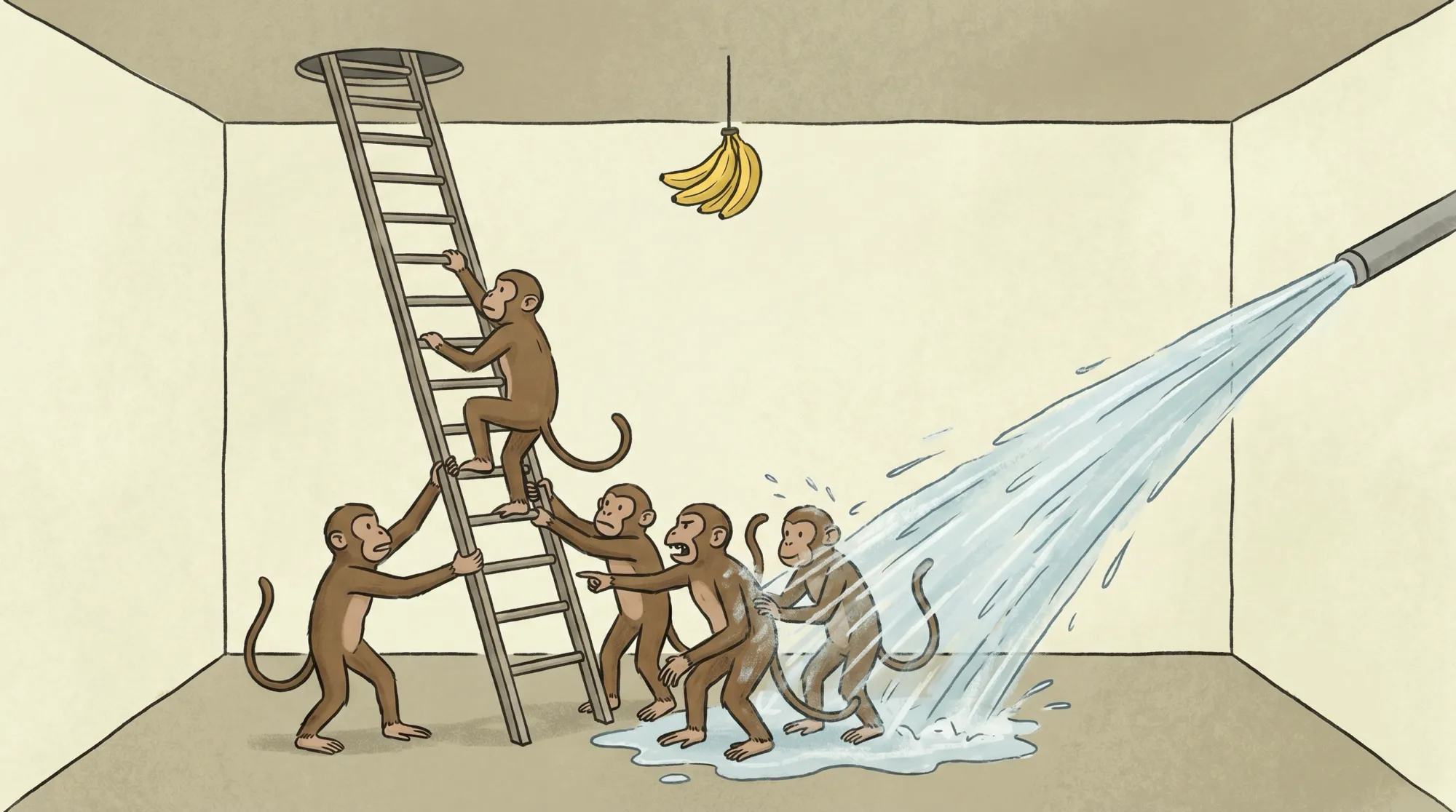
Five monkeys are locked in a cage. Every time one of them tries to reach a bunch of bananas hanging at the top, all the monkeys get hit with a strong jet of water. The monkeys stop trying. Now the keeper starts swapping them out one by one. New monkeys come in and naturally try to get the bananas. The old ones pull them back. Step by step, all ten monkeys are replaced. Not one of them has ever experienced the water jet.
And yet the group still prevents anyone from going for the bananas.
Nobody knows why anymore. It’s just how things are done.
Sound absurd? Look around your organization. Are there things that have “always been done this way,” without anyone being able to explain why? Maybe you’ve seen a new colleague ask exactly that question, and everyone smiled briefly. Welcome to company culture.
That’s how cultural patterns work. They outlast the people who originally shaped them. And yet they determine behavior every single day.
This has an important consequence: organizational culture cannot be fully described from the inside. Someone who uses it every day can barely step outside of it and reflect on it. That’s not an intelligence problem. It’s a structural feature of every social system. You can tell me a great deal about your processes and structures. But about your own company culture, you’ll inevitably have little useful to say, not because you don’t want to, but because you’re right in the middle of it.
What an Outside Perspective Reveals About Company Culture

If organizational culture isn’t directly accessible, how do you get to it?
Not through a survey. Not through a workshop where values get written on sticky notes. What works is confronting people with hypotheses about their own backstage, what’s really going on beneath the surface, the informal reality that insiders rarely get to see clearly.
In my work, I conduct a series of connected conversations with people inside an organization. I don’t confront them with questions they could already answer. I confront them with patterns and images I observe. “I believe this is how things work here.” The reaction, whether a smile, strong resistance, or a precise counter-argument, tells me more than any direct answer would. That’s how the picture sharpens across conversations.
This is not a psychological trick. It’s the joint examination of an informal reality that insiders can’t see, precisely because they use it constantly. A bit like looking through a keyhole together: one person looks from one angle, another from a different one. And slowly a picture of the room behind it takes shape.
What This Means for Leaders

And now the key question: what do you do with this knowledge?
The goal is not to produce a specific target culture. You can’t do that. The goal is to understand which cultural patterns support or block value creation.
When every request for internal help in an organization gets answered with “Give me the cost center number so I can charge this,” that’s a cultural pattern. Behind it, there’s almost certainly a structural premise, a cost allocation system, an incentive mechanism that punishes collaboration. Once you understand that connection, the probability of a structural intervention changing the pattern increases significantly. Not guaranteed. But far more likely than a workshop on “How do we become more collaborative.”
The other direction matters just as much. When an organization functions exceptionally well despite its size, when people take ownership, make decisions quickly, and collaborate, it’s worth understanding why. Which structural premises make that possible? What should a leader absolutely not touch, because doing so would destroy exactly that company culture?
Protecting organizational culture is at least as important as trying to improve it.
Conclusion: Understanding Company Culture Instead of Mandating It
Have you ever experienced a culture change in your organization that actually changed something? And if so: what changed structurally before anything changed culturally?
Organizational culture cannot be mandated. It can be observed, understood, and indirectly influenced by changing the structural conditions under which people work every day.
Those who understand this stop spending energy on values workshops and posters. And start asking the right questions: which of our rules produce the patterns we experience every day? And which ones protect what makes us, as leaders and as an organization, successful?
The shadow doesn’t lie. You just have to learn to read it.
Get in Touch
If this article has made you look at your last culture initiative differently, that’s a good place to start. A closer look at the structural rules that are actually shaping your company culture right now tends to be more revealing than most people expect.
In an initial conversation, we look together at the decision premises in your organization and what they reveal about the patterns you’re experiencing. No charge, no pitch, no obligation.