


27 Apr We Outgrew Our Name. And Our Thinking. Design Sprints Studio is Now CoHive.

For more than six years, the company was called Design Sprints Studio. That name was accurate. It described what the work looked like at the time: running sprints, facilitating workshops, developing strategy, training teams, and consulting on product and innovation challenges. Helping leadership teams and organizations move faster and think more clearly about the problems in front of them.
It stopped being accurate quite a while ago. In fact, it has been outdated for years.
The work had shifted. Not suddenly, and not by accident. It shifted because the real problems kept showing up one level deeper than the workshop room. A sprint lands. The session works. People leave with energy and clarity. And three weeks later, the same patterns are back. Not because the format was wrong. Because the conditions around the work hadn’t changed.
We still run workshops. We still facilitate, train, and consult. But a workshop is only a useful intervention if it connects to something structural. Isolated events without follow-through are expensive conversations. The question I kept returning to was why change doesn’t stick. And for a long time, I was looking for the answer in the wrong places.
Contents
Why Leadership Programs and Organizational Development Often Don’t Stick

Early on, I was convinced that the right expert would fix the problem. Hire a serious name, bring in proven knowledge, and things will change. The disappointment was almost always the same.
The real issue isn’t that experts are wrong. It depends entirely on what kind of problem you have. For a technical problem — software architecture, compliance, financial modeling — the answer exists. Someone trained enough can find it and apply it. That works. Dr. Gerhard Wohland calls this the domain of knowledge: documented, transferable, teachable. The right expert carries it, and the organization benefits from it.
Leadership, collaboration, and organizational structure are different. These problems don’t require knowledge. They require ideas, and ideas can’t be imported. The answer has to be discovered inside this specific system, with these specific people, under these specific conditions. What worked somewhere else is data at best. At worst, it’s a distraction. An expert can help you see the system more clearly. But they can’t hand over the solution, because there isn’t one yet — not until the organization produces it.
So I spent years believing in methods instead. Learn the right framework, apply it correctly, and things will change. This is sometimes true. But the results rarely held.
What I understand now: it was never about the expert, and it was never about the method. What determines whether organizational change actually happens is the system people are working in. The structures that shape how decisions get made. The patterns that reward certain behaviors and quietly discourage others. The way authority is actually distributed, regardless of what the org chart says.
A good tool in the wrong conditions changes nothing. A clear principle in the right conditions changes everything.
The Real Problem in New Leadership and Team Development

Which brings the question back to conditions. Most organizations I work with are not short on strategy, tools, or effort. What they are short on: leaders who create real conditions for good work, and teams who actually own their results, not just on paper.
The symptoms are familiar. Decisions that should take an hour take three weeks because everyone is waiting for someone else to sign off. Teams that are capable and motivated but spend most of their energy navigating internal friction. Leaders who are exhausted from being in every conversation that matters. Workshops that generate real insight and disappear into routine like they never happened.
The cost of this is not just frustration. It’s real value that never gets created. Work that happens, but doesn’t solve anything for anyone outside the building.
This is not a people problem. The people are usually good. It’s a structural problem. And structural problems don’t get fixed by better communication training or a two-day leadership offsite, however well-designed. The question is what actually does fix them.
New Leadership and Organizational Design: Two Levels of Change

New Leadership, in this sense, doesn’t mean less direction. It means direction that creates real conditions for good work, instead of replacing the judgment of the people doing it. Not the leader who has all the answers, but the leader who builds the conditions under which the right answers can emerge.
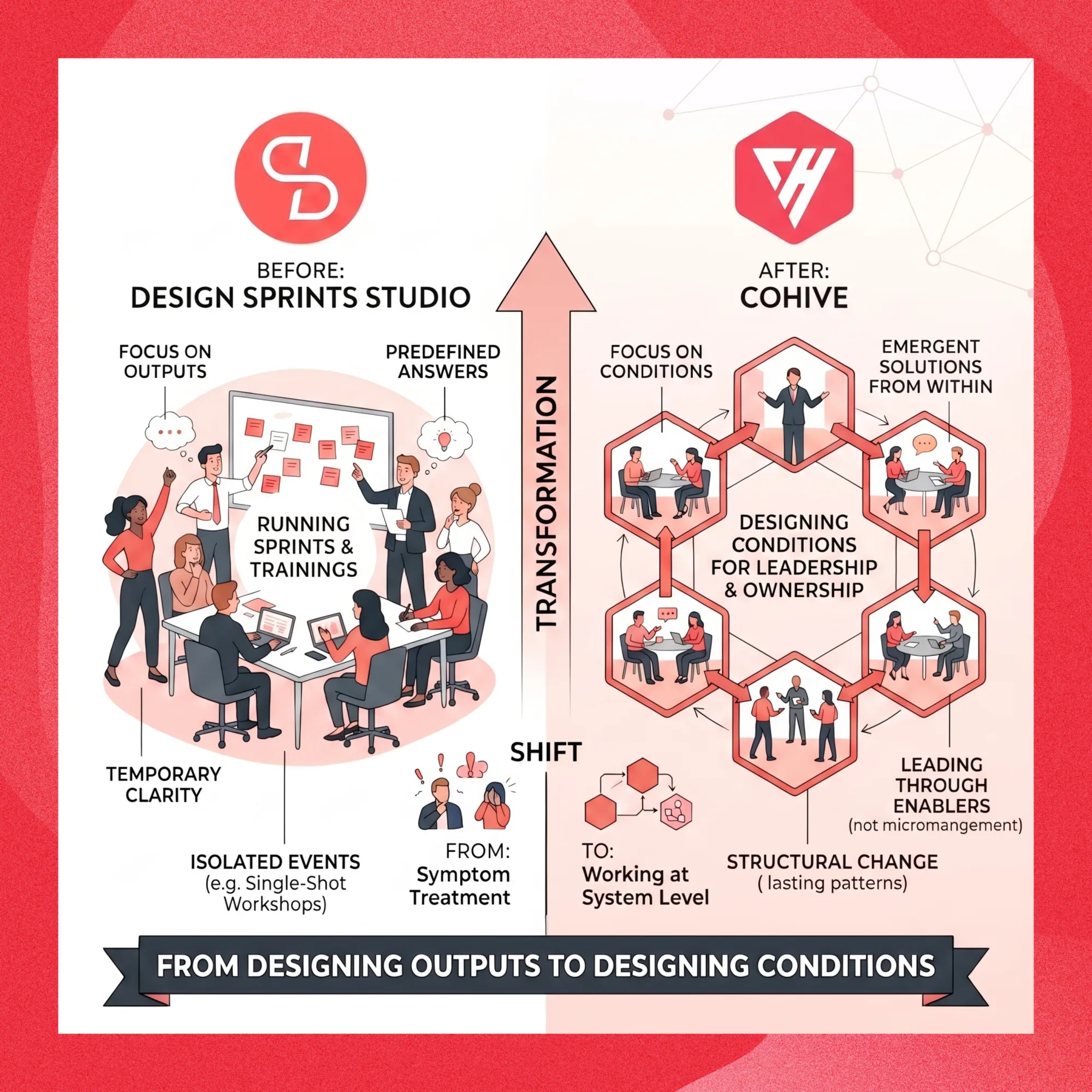
That’s the shift CoHive is built on: from designing outputs to designing conditions. From symptom treatment to working at the level where patterns actually change.
Structural work is the primary lever here. Change the decision structures — who decides what, on what basis, with what information — and many behavioral problems resolve without anyone changing their personality.
But there’s a second level worth naming separately. Individual leaders operate inside structures, and they also bring their own patterns to every situation. Patterns that shape how they read a room, handle ambiguity, or respond when things get uncomfortable. These don’t dissolve automatically when the org chart improves. Coaching that works at this level — how someone actually thinks and responds under pressure, grounded in psychodynamic understanding — is a different kind of work. Not a substitute for structural change, and not a parallel path to the same destination. A separate intervention for what structural design can’t reach.
What CoHive Actually Stands For
The name is not a coincidence.
Co comes from co-creation. Not as a buzzword, but as a working principle. Real organizational change doesn’t get imported from outside and installed. It emerges from inside the system, built by the people who have to live with it. The role here is not to deliver a solution but to create the conditions where the system can see itself more clearly and generate its own answers. That requires working together, from within, without pretending the consultant holds the key.
Hive evokes something specific: a space where people with different competencies come together around a shared problem, and where intelligence lives in the collective, not just at the top. Decisions go where the knowledge is, not where the hierarchy points. Leadership in this sense is not about having the answers. It’s about building and protecting the conditions under which the right answers can emerge, from the people closest to the problem. Not managed into compliance. Enabled to contribute fully.
In the end, this isn’t just about efficiency. It’s about the difference between work that creates real value and work that merely looks like it. Between genuine output and organized busyness. Between a team that solves real problems for real customers, and one that spends its energy on internal theater. That distinction is what the work is built on. And it’s what good conditions make possible.
Get in Touch
If something in this resonates, it’s probably worth a direct conversation. Whether you’re a leader stuck in patterns you can name but can’t resolve, a founder whose organization can’t scale without you in every decision, or a team responsible for transformation that actually sticks — the first step is the same. An honest exchange about what’s going on, what you’ve already tried, and whether working at the structural level makes sense for your situation. No pitch. Just a real conversation.