


20 Oct Why Conflict in Change Management Isn’t a Failure, It’s Proof of Real Change
And what that means for your company’s next change initiative

Every change program that promises universal, enthusiastic buy-in is lying. The promise can’t survive contact with how change actually works. It’s that simple.
I’ve never once seen a change project in my consulting and coaching practice run without friction. There’s always someone who says, quietly or not, “This worked fine before, why are we changing it now?” That’s not a coincidence. Conflict in change management just comes with the territory, whether you like it or not.
The reason is simple. Change means replacing something old with something new. When you decide the old way no longer fits, you’re also telling the people who built or defended it that they now need to think differently. The technical term for this is negation. Put plainly, you’re contradicting what used to hold true.
And that’s exactly what automatically triggers conflict communication inside the organization. For every single change initiative, you have to accept that and plan for it from day one. The rest of this article explains why that’s true and what it means in practice.
Contents
Why Every Change in Organizations Declares the Old Way Wrong
Why That Automatically Triggers Conflict Communication
Why “Change Without Resistance” Is a Sales Pitch, Not a Concept
Planning for Conflict in Change Management Instead of Smoothing It Over
Conclusion: What Conflict in Change Management Means for Your Company’s Next Initiative
Why Every Change in Organizations Declares the Old Way Wrong

There’s a simple way to frame this in organizational design. If conflict served no purpose, evolution would have phased it out long ago. What works sticks around. What doesn’t fades away. Conflict has existed for as long as people have organized themselves, in every company, in every relationship. So it serves a function, whether we like it or not.
Change initiatives are a textbook example of that function at work. Every change project implicitly says: the way things have been done isn’t good enough anymore. That’s a judgment, and judgments provoke reactions. Someone who believed their previous approach was right will push back against the new judgment rather than simply accept it. That has nothing to do with stubbornness. It’s the logical result of two different readings of the same situation colliding.
That’s why the phrase “change resistance” is actually a bit misleading. What’s really happening is a communicative reaction to a negation, not resistance to change as such. When someone says in a meeting, “We’ve always done it this way, and it worked,” they’re not defending the old method for its own sake. They’re pushing back against having their previous work declared wrong. Every change initiative negates something. And every negation provokes a response from the system.
Why That Automatically Triggers Conflict Communication

Conflict communication follows a simple, well-documented pattern. A no is more likely to be met with another no than with a yes. Once two nos are on the table, they reinforce each other. That’s the moment a disagreement turns into a conflict.
The mechanism behind this is more mundane than it sounds. Someone who feels misunderstood usually corrects their own assumption about what the other person understood. What the other person actually said barely matters anymore. The pushback ends up aimed at the imagined misreading of what they said, hardly at what was actually said. That sets off a spiral neither side can easily step out of, because every new comment gets read as further proof that they’re not getting through.
Change communication falls straight into this pattern the moment it starts. Leadership says: the old way doesn’t work anymore. The people affected hear: you’ve been doing it wrong. That’s already a no answered by a no, long before anyone says the word “resistance.”
Why “Change Without Resistance” Is a Sales Pitch, Not a Concept

Because nobody wants to hear this dynamic spelled out, there’s an entire market of change frameworks claiming the opposite: change without friction, everyone on board, only upsides, no losers. That sounds great in a kickoff deck. It doesn’t survive contact with reality, for the simple reason that it would have to suspend the basic laws of communication to be true.
A lot of conflict guides remind me of paint-by-numbers kits. You follow a fixed set of steps and expect a finished picture at the end. But neither conflict management nor real change works that way. Both are closer to craft than to technique. You have to pay attention to what’s actually happening instead of running through a template.
The comparison between trivial and non-trivial systems makes the difference tangible. When your car goes into the shop, it either comes out fixed or it doesn’t. It’s a one-time, closed-off state. Organizations don’t work that way. They’re more like brushing your teeth: you can’t say you brushed today and that’ll cover you for the rest of your life. Conflicts in organizations can’t be solved once and for all either. They have to be worked through again with every new change initiative.
Promising a client you’ll resolve a conflict for good is a promise these systems simply can’t keep. By “system,” I don’t mean anything technical, I mean the organization as a whole: the ongoing web of communication and decisions that keeps rewriting itself, no matter what anyone does about it. A promise like that is simply a category error.
Planning for Conflict in Change Management Instead of Smoothing It Over
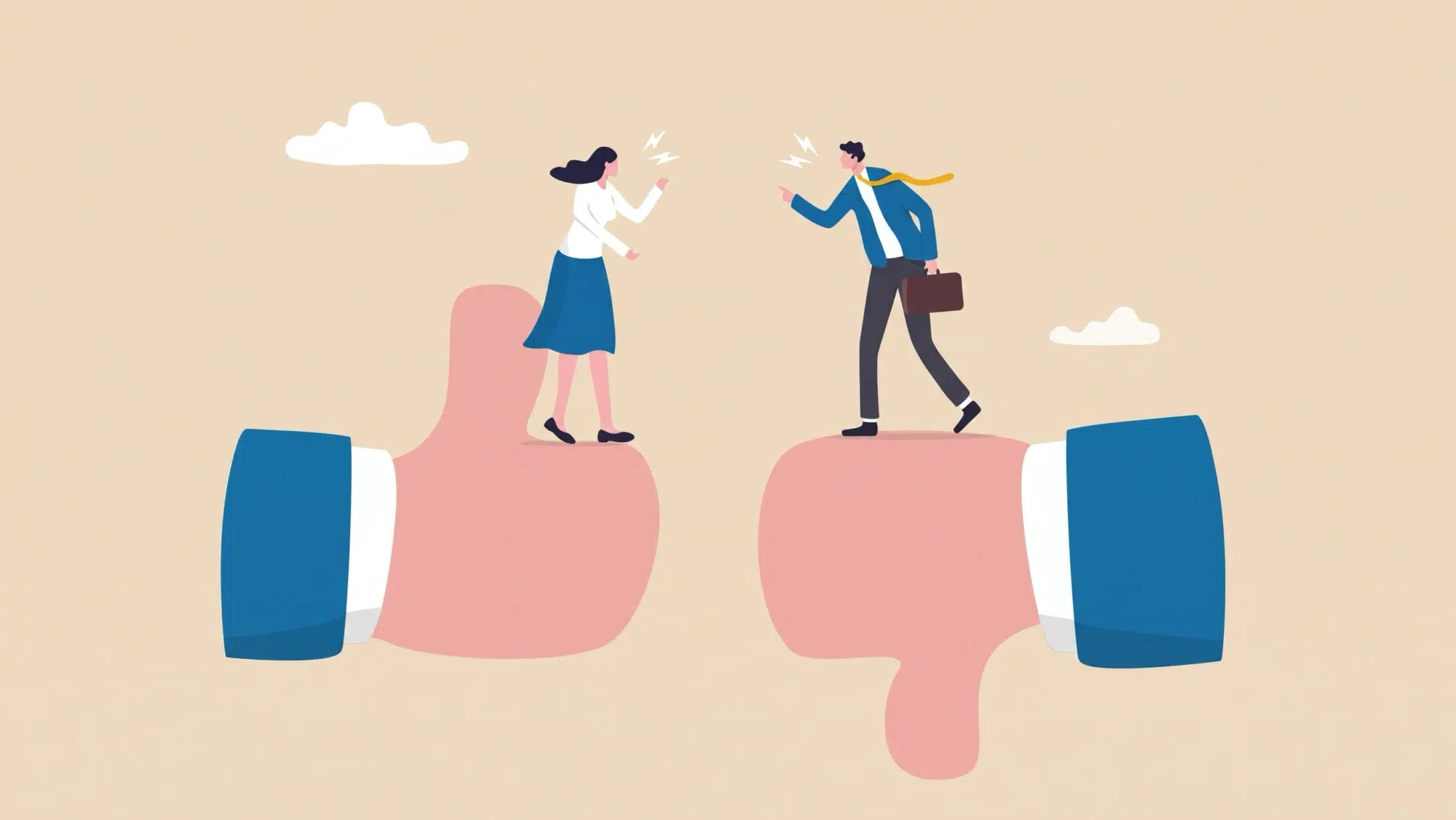
In my experience, the main mistake in handling conflict is a one-sided approach. People zero in on one of three dimensions and ignore the other two.
The Three Dimensions of Every Conflict in Organizations
📌 The Substantive Dimension – what the disagreement is actually about, the real question at stake
🤝 The Relational Dimension – how power and responsibilities shift between the people involved, how much trust exists between them, and how people treat each other
⏳ The Temporal Dimension – how the conflict has developed over time and where it’s heading, whether it’s escalating or dying down
Some consultants and coaches deal only with the substantive question and couldn’t care less how much resentment builds up along the way. Others make sure everyone feels good about each other again without ever settling who actually knows what they’re talking about. Both leave half the job undone.
For change processes, that means conflicts can’t be smoothed over by getting everyone back on board with a bit of goodwill. Focusing only on the relational dimension while the substantive disagreement stays unresolved buys you harmony at the expense of the actual issue.
Practical Examples
🗣️ The budget fight after a reorg: Two department heads openly disagree over who will own the budget for a shared project going forward, a classic substance issue. Leadership schedules a team workshop to improve collaboration. The whole day goes to communication and trust-building, to helping the two of them get along better. By the end, everyone’s on friendly terms again, and the feedback on the workshop is good. The actual budget question never comes up once. Three months later, the next budget decision rolls around, and the same fight breaks out again, this time dressed up as a “communication problem.” In the end, they worked through the relational dimension and never touched the substantive one.
🗂️ The org chart that misses the humiliation: On paper, a new matrix structure cleanly lays out who’s responsible for what and who reports to whom. What the chart doesn’t address: the department head who loses two of his three teams in the reorg is never acknowledged for his previous work. He experiences the change as a quiet demotion, even though nobody formally blames him for anything. That sting is never named. He signs off on the new structure but drags out operational decisions in what’s left of his area for weeks. He isn’t sabotaging anything on purpose. He’s just lost the motivation to invest in the new setup after the quiet demotion. Nobody connects the dots back to the reorg. The substantive dimension got handled cleanly while the relational dimension was left completely untouched.
🤖 The AI rollout that ignores status: A company rolls out an AI tool and justifies it purely on the merits: faster processes, fewer errors, better numbers. The message comes wrapped in lines like “everyone’s doing this now” or “it’s simply better.” What’s missing from that message is any engagement with the relational dimension, namely what the shift means for the status and expertise of the people who have been doing the very work that’s now being automated. An Ipsos study on AI and job anxiety in Austria, together with international surveys from EY, WTW, and Adaptavist, shows exactly this pattern: fear of AI is less often about the technology itself and more about a personal loss of relevance inside a system whose new rules aren’t yet clear. When people’s expertise gets called into question by a new technology, they tend to withdraw and hold onto what they know rather than raise concerns openly. Here too, only the substantive dimension got addressed, while the relational dimension was completely ignored.
All three cases are change initiatives undone by the same one-sidedness.
Every change initiative negates something that already exists, and that’s exactly why it automatically brings conflict communication into the organization. Planning for that upfront, instead of denying it, buys you something decisive: the ability to work through the conflict deliberately instead of being blindsided by it. That’s the difference between minimally invasive organizational development that doesn’t rely on big programs and a change project that trips over its own promise of harmony.
What That Looks Like in Practice
Each of the three dimensions plays out differently day to day.
The Substantive Dimension: The actual point of disagreement has to be resolved, not papered over by everyone feeling good about each other. If people reach an agreement but nobody can say afterward what was actually decided, all that got resolved was the mood, not the issue.
The Relational Dimension: This means being upfront about how power, responsibilities, and accountability actually shift as a result of the change, instead of glossing over it. Someone who used to hold responsibility and now hands it off loses something, regardless of how sound the new setup is on paper. Nobody needs to turn that into a therapy session. It just needs to be said out loud, instead of pretending nothing changes for the people affected.
The Temporal Dimension: A conflict can’t be declared closed after a single workshop. It has to stay on the radar for as long as the change initiative runs. A conflict that looks settled today can resurface at the next decision point if the root cause was never actually addressed.
None of these three jobs can be outsourced or checked off in a single meeting.
Whether that work is actually happening usually shows up in the tone of the steering committee itself. When nobody in the room pushes back anymore, that rarely means everyone’s convinced. I’ve written about this elsewhere, in a piece on why a conflict-free organization is a warning sign, not a win. The disagreement doesn’t disappear. It just moves, to the grapevine, to quiet foot-dragging, to the next resignation.
Conclusion: What Conflict in Change Management Means for Your Company’s Next Initiative
Starting a change initiative without planning for conflict doesn’t get you a better plan. It just pushes back the moment the conflict becomes visible, usually to a point where you have less room to maneuver.
In practice, that means conflict in a change process is normal once the status quo is being seriously challenged. It’s a sign that something is actually moving. What matters is whether you work through it across all three dimensions, substantive, relational, and temporal, or settle for the one dimension you’re most comfortable with and end up wondering why the change project stalled anyway. Most change initiatives fail because everyone gravitates toward the dimension that comes easiest to them and quietly ignores the other two.
An organization that allows conflict during change instead of suppressing it is demonstrating that it’s actually changing something, not just putting old wine in new bottles. That’s also a useful diagnostic: if a change process stays quiet the whole way through, it’s worth asking whether anything is really changing, or whether people are just going through the motions.
That idea connects directly to another point. Big programs often promise exactly the kind of frictionless, conflict-free rollout that isn’t structurally possible. Working instead on the reasons conflicts in organizations can’t be resolved, only managed gives you a more realistic foundation for change.
Get in Touch
If your change initiative is stuck at the point where everyone formally agrees and nothing moves forward anyway, it’s worth looking at the conflicts that are in the room but never said out loud. That’s usually more productive than one more communication format.
In an initial conversation, I’ll help you spot where the real levers are in your organization. No charge, no pitch, no obligation.