


17 Jul Why Jonathan Courtney Hated His Own Company AJ&Smart — and What That Reveals About Structure (Not Culture)
Organizational Teardown: A remote diagnosis based on a single podcast—nothing more, nothing less—from the co-founder’s perspective, not the team’s.
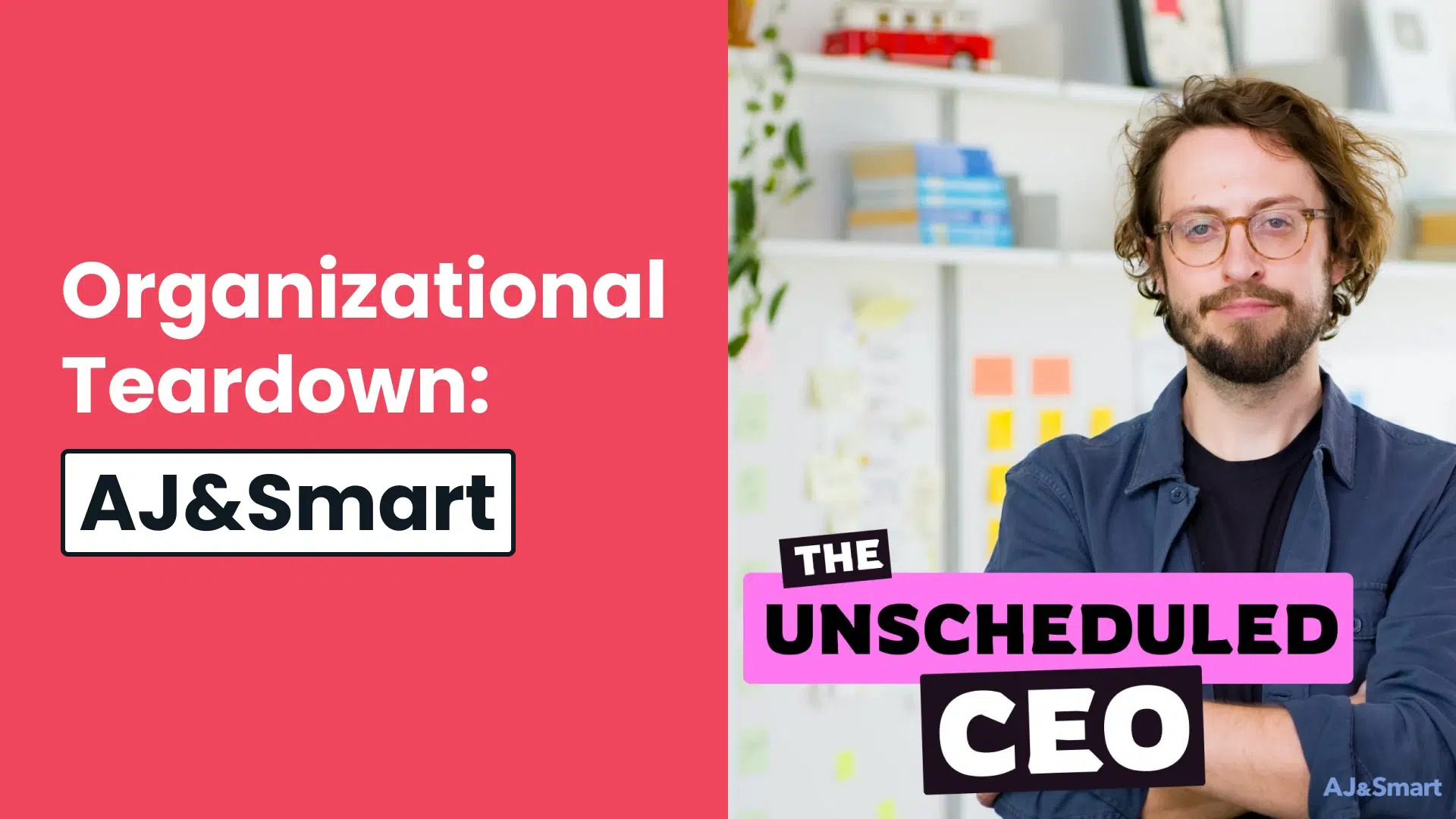
💡 I’m trying something new here: the written version of a reaction video, for an episode that’s out there both as a podcast and as a YouTube video.
The idea: I listen to what founders say in public and unpack it through my own professional lens, as a coach and consultant who works on leadership, organizational, and innovation development, looking at both the structural side of a business and the psychodynamics of the people and teams inside it.
The first case I’m covering here: Jonathan Courtney, co-founder of AJ&Smart. I’ve been a client of AJ&Smart myself for years, so this isn’t a pure outsider’s view. AJ&Smart is a Berlin-based studio for product design and business strategy, known today mainly for its facilitation training, above all the Design Sprint, the method Jake Knapp developed at Google Ventures.
Seven years in, the company grows from two people to thirty-six, and somewhere between 2018 and 2022, Jonathan starts hating it. Not a little. He says on the podcast Unscheduled CEO that he seriously considered giving the company away or shutting it down for good. Hearing that was enough to make me want to take it apart properly.
Two Caveats Up Front
Before I go further, two caveats worth stating upfront. First, everything here is a read, not a confirmed diagnosis. I’m working entirely from what Jonathan says in one podcast episode, read as carefully as I can, but with no claim to completeness. Second, and this one matters more: I only have his side of the story, the owner’s, not his employees’, and you’d really need both for a complete picture. What follows is an informed outside view, not a case file.
One more thing before we start: anyone who’s held this role before, me included, recognizes some of these mistakes firsthand. This isn’t an attempt to put anyone on trial or hold them up for ridicule. It’s a sober look at what happened here, structurally and humanly. That hopefully sharpens the read rather than clouding it.
Contents
Structure, Not Culture: Red Problems, Blue Playbooks
Value Creation, Not Busywork: Why More People Delivered Less
Missing Decision Premises: Why Every Call Landed on the CEO Personally
Where Structure and Conflict Avoidance Met
The Safe Space He Built Out of Desperation
The Story, Short
Unscheduled CEO is Jonathan’s own podcast, where he mostly talks about business topics and his role as CEO. For anyone who hasn’t heard the full episode or seen the video, here’s the short version: a co-founder imports practices from a completely different kind of business, leaves key decisions with no clear owner, and avoids conflict where he could resolve it, until he ends up wondering why he can’t stand his own company anymore.
In detail: AJ&Smart grows between 2011 and 2018 from two co-founders to thirty-six people, right alongside the rise of the Design Sprint as a method. That’s around when I bought my first AJ&Smart product and trained as a Design Sprint trainer myself. As the company grows, Jonathan adopts practices from role models like Facebook and Basecamp: perks, employee programs, a very casual internal tone. At the same time, structure is missing elsewhere. As becomes clear later, a habit of avoiding conflict makes it worse: decisions that should clearly sit with one role are never written down, and keep landing on Jonathan personally instead, everything from pay raises to team conflicts
The mood turns. An anonymous employee survey gets worse every year. Jonathan steps back as CEO for a while, hands the business to someone else, and moves to the board himself, and the company loses €1.2 million in a year. Meanwhile, mostly just to escape all of it, he builds a completely separate unit, which later becomes facilitator.com. When he comes back as CEO, he gradually shrinks AJ&Smart down to six people over the following years. Today he says it’s the best stretch of his entire career. What looks like a culture problem here, entitlement, sinking morale, a company that feels like a stranger, turns out on closer inspection to be mostly a question of missing structure. That’s exactly what we’ll look at, piece by piece, from here.
Structure, Not Culture: Red Problems, Blue Playbooks

As AJ&Smart grows, Jonathan starts adopting practices from companies he admires. He flies out to the Facebook campus in Menlo Park, sees the perks in person, and figures, we need this too. Something similar happens with Basecamp: Jonathan says outright that they were doing a lot of perks and employee incentive programs, and that AJ&Smart wanted to be like them, more on that in the next section.
Why that didn’t work is explained by a distinction drawn by Dr. Gerhard Wohland — a physicist, management consultant, and pioneer in organizational development — between two types of problems. Red problems are complex, with no answer knowable in advance, solvable only through ideas, judgment, and decisions made in the moment. Blue problems are complicated but known, solvable through an established method or expertise that can be planned ahead of time. The actual client work at AJ&Smart, a new Design Sprint every week for a new company with a new business problem, sits mostly on the red side: the five-day format is standardized, but what it’s used to solve isn’t, that takes ideas and judgment, not a known process, and the answer that comes out the other end is only ever a hypothesis, an entrepreneurial bet that still has to prove itself in the market.
Facebook is a good example for thinking through the blue side of this. Perks work on the same logic as a solution to a blue problem: there’s an established playbook for what a competitive perks package looks like, you can benchmark it, plan it, buy it off the shelf. Facebook could execute that playbook well because it has close to unlimited capital behind it. But even where perks fit the problem type, they come with a cost of their own: they shift people’s attention from an external reference, the market, the customer, the problem actually being solved, to an internal one, who has what, who’s being treated fairly compared to whom.
Here’s one way to read what happened next, using Wohland’s own distinction, even though Jonathan never puts it in these terms himself: what he copied from Facebook and Basecamp made AJ&Smart more dynamic-fragile instead of dynamic-robust. A dynamic-robust organization can absorb shifts in its market without breaking. A dynamic-fragile one is optimized for stability instead, and snaps under pressure. What Jonathan actually describes fits that pattern: the perks created entitlement and complaints instead of goodwill, and the rituals his coaches introduced made the annual survey worse, not better. Structure built for a stable, well-resourced company added friction to one that needed to stay close to a market that changes with every client, rather than delivering the stability it seemed to promise.
The Basecamp Misreading
Jonathan himself brings up a second example in the podcast, Basecamp, and the real story behind it is worth getting right, because it usually gets told wrong. On a side note, I’ve followed Basecamp co-founders Jason Fried and David Heinemeier Hansson myself for a while and have enjoyed reading some of their books, but that doesn’t change what happened here. Basecamp had spent years positioned as the anti-Silicon-Valley company, no ping-pong tables, no free lunches, instead a company that stood for radical openness and flat structure. In April 2021, Fried and Hansson announced in a blog post that they were banning societal and political discussion from the company’s internal tools. What triggered it was an internal fight over a years-old, informally kept list of “funny” customer names, several of which leaned on racist stereotypes. Instead of letting the conflict play out in the open, leadership tried to end it by decree. Of the 57 employees at the time, 18 took a severance package and left within days, including several long-tenured staff. Fried later apologized publicly for how the announcement had been handled, but kept the new policy in place.
What’s interesting here isn’t that a borrowed culture backfired, it’s the opposite. Basecamp had spent years building a genuine culture of openness, and that culture couldn’t simply be switched off by decree. Culture comes out of repeated decisions, not a single directive, and that’s exactly why it can’t be undone by a single directive either. I’ve written elsewhere about why company culture can’t simply be decided. That’s the flip side of what happened at AJ&Smart: there, structure was missing; here, a culture that had grown over years collided with a sudden structural order from the top. Both cases make the same point: pitting structure against culture doesn’t get you anywhere. The two need to be worked on together.
Value Creation, Not Busywork: Why More People Delivered Less

The Content Team Example
The clearest evidence for the real problem isn’t the perks, it’s AJ&Smart’s content team. At the start, one person alone ships a video a week; by the end, eight to twelve people are doing the same job, and fewer videos come out, not more.
There’s a simple distinction that explains this. Value creation is work that actually solves a problem in the market, in this case a video that reaches viewers. Busywork is activity that looks like work but doesn’t create any extra impact on the outside: more people, more meetings, more back-and-forth, without any more of it actually reaching the viewer.
Why More Heads Don’t Mean More Output
Some work breaks down into pieces that add up, ten people each filling out one form produce ten times as many forms. A video that lives or dies on timing, tone, and a single creative call doesn’t work that way. It doesn’t need more hands, it needs one clear answer to who makes the final call. Every extra person allowed a say in that kind of decision raises the number of possible disagreements faster than it raises the number of finished videos. It’s the same reason team performance on complex, situational work doesn’t come from adding up individual contributions. It comes from how well people work together, and that kind of output can’t really be broken down by person, let alone scaled up just by throwing more headcount at it.
Jonathan himself chalks this up to a motivation problem, his team just wasn’t as engaged anymore. More likely, it’s a mix of two things. First, throwing more capacity at a problem that runs on judgment, not capacity, gets you more coordination overhead, not more output. Second, and this is Jonathan’s own account, not my guess: he says outright that it led to infighting and power struggles on the team. When eight people are fighting over the same creative call with no agreement on who has the final word, competition over status is close to inevitable. So this was less a motivation problem than the predictable result of throwing capacity at something that was never a capacity problem to begin with, and putting people straight into that gap without giving any of them a clear role.
The Counter-Proof: Sam Ovens
Jonathan himself, without framing it this way, offers a counter-example. He talks about Sam Ovens, an entrepreneur whose company does roughly the same revenue as AJ&Smart with about a third of the headcount, at a better margin, with no one-on-ones, no career conversations, not even its own office management team. A cleaner comes in once a week, and that’s all the admin the place needs. Being small isn’t really why it works. It works because that company only ever built the structure its actual work requires, and never layered a second story of administration on top.
No Argument Against New Work
What went wrong here has little to do with New Work in any real sense, more with a common misreading of it. I work with a lot of New Work principles myself, but real autonomy, or real self-organization, means a person or a team can actually make a call, with real authority and real accountability attached to it. That’s different from neglect, where nobody bothers to clarify who’s responsible for what and everyone’s still expected to sort it out somehow. It’s also different from employee happiness treated as an end in itself, or installing a ping-pong table. Neither one solves a single structural problem, and neither has much to do with value creation, which is what should actually come first. That’s its own common misreading of New Work. AJ&Smart is a good example of what happens when real autonomy gets confused with its surface-level version.
Missing Decision Premises: Why Every Call Landed on the CEO Personally

The €800,000 Question
One moment in the podcast shows how differently decision-making authority can be resolved, and that Jonathan’s own model isn’t automatically the worse one. A founder friend tells Jonathan about a decision of his own: before he can commit to a possible €800,000 call, he has to check with his own team first, specifically with a designer who’s on vacation. At AJ&Smart, it works differently: Jonathan decides himself, and the team finds out afterward, sometimes via his own podcast. The other founder is stunned that this even works, without anyone feeling steamrolled. That’s the sign that decision-making authority and informal acceptance lined up here, at this point, his model worked.
Formal Power and Informal Authority
The difference between the two companies isn’t a matter of personality, it’s a matter of power and authority, in a very concrete sense. There’s formal power, the official right to make a call, and informal authority, the actual weight a person carries on a team regardless of title. Where both line up and everyone on the team knows it, you don’t get long rounds of back-and-forth. Where decision-making authority is never clearly assigned, the organization fills the gap on its own, usually informally and rarely transparently, and a designer’s vacation suddenly becomes the blocker on a six-figure call.
The Raise Conversations
At AJ&Smart, this same gap shows up even more clearly, just less comfortably. Employees come into Jonathan’s office in tears, asking for a raise. He decides on the spot, gives in, word gets around, and others show up too.
As Jonathan puts it, more or less: he had no idea how to handle it.
It reads like an emotional problem, but it’s really a missing decision premise. There was no role, no process, no one with clearly delegated authority over pay. So every individual case didn’t land with a role built to absorb it, it landed directly on one person, who happened to also own the company.
When Care Is the Wrong Answer
The coaches Jonathan brought in during this period made things worse, not better. They added more caretaking rituals: biweekly one-on-ones, employee advocacy sessions, more relationship work in exactly the spot that needed a clear rule instead. It’s the same misreading as the perks: a well-meant gesture of care standing in for real structure instead of adding to it. The result shows up in a number Jonathan mentions himself: the anonymous employee survey got worse every single year despite all of it. More care can’t substitute for missing structure around pay decisions, it just shifts the problem from the raise conversation into the next one-on-one.
That doesn’t mean a written rule makes the desire for more money disappear. People will still ask, that’s normal and fair. What changes is how the question gets answered. Without a rule, every person negotiates one-on-one with the owner, and whoever shows up the most desperate has the best odds. With a clear, written rule, fixed criteria or a set review cycle, say, nobody’s negotiating with a person anymore, everyone’s dealing with the same process. That doesn’t make the answer more pleasant, but it makes it more consistent and fairer, and it takes the owner out of the role of sole arbiter. That’s exactly what was missing at AJ&Smart, not a ban on wanting a raise, but a process that catches the question before it lands on one person.
The Honest Employee Handbook

What the Handbook Says
At AJ&Smart, most expectations stay unspoken, never turned into a rule or a principle. In one place, Jonathan does the opposite, and it shows he already knew the answer: he writes an uncomfortable truth down explicitly. AJ&Smart has an employee handbook, partly modeled on Valve, the American game company behind Steam, itself known for a strikingly candid internal handbook. It states plainly where AJ&Smart is weak: poor onboarding, no reliable mentoring, no good internal flow of information. New hires read it before they sign.
The first half of that is smart. An honestly named weakness replaces a silent expectation with an explicit one. Anyone who reads the handbook before signing knows what they’re getting into, which beats promising good onboarding and then failing to deliver it.
The second half is weaker than it looks. The handbook even names the cost of its own weakness, it states that the company loses out on talented people who need a more structured environment. But it stops there. Jonathan says himself that hardly anyone at AJ&Smart is particularly motivated to fix it, there’s no real incentive to right now. That’s the difference between an observation and a decision. An observation states what is. A decision would say why it’s meant to stay that way, and what the company is knowingly trading off for it. Without that second step, the honesty has no consequences: the same weakness hits every new round of hires all over again, with nothing about the underlying reason ever changing.
Where Structure and Conflict Avoidance Met

The Moment Before the facilitator.com Launch
Up to this point, this has been a story about missing structure. But there’s a moment in the podcast that shows structure alone doesn’t explain everything, and I don’t want to leave it out, even though it’s more of a reading than a proof.
Jonathan describes being afraid, before building facilitator.com, of upsetting the existing consulting team, worrying about how to present the new direction without anyone on the old team feeling sidelined. He says himself that this is where he started playing politics, and that he didn’t want to. That’s not really a structural problem, it’s conflict avoidance, a very human pattern: someone who’d rather delay an uncomfortable announcement than risk a reaction.
Why Conflict Avoidance and Missing Structure Reinforce Each Other
The point here isn’t that structure doesn’t matter, it’s that conflict avoidance and missing structure fed each other. A founder who avoids conflict rarely builds structure that channels conflict, clear roles for pay decisions, for instance. And an organization without that structure rewards exactly this avoidance, because on the surface, things look calm. Fix only the structure without understanding the pattern, and you’ll probably just find a new way to avoid the same conflict. Work only on the pattern without changing the structure, and the next escalation lands in the same spot all over again.
The Safe Space He Built Out of Desperation

A New Unit, Cut Off From Everything Else
The cleanest move in the whole story was unintentional. At some point, Jonathan builds a fully separate unit, first under the name Digital Experiments, later as facilitator.com. Its own office, its own team, none of the old rules, no contact with what he himself calls “infected.”
At its core, this is a safe space: a new organizational form, tested on a clearly bounded slice of the business, structurally cut off from the rest, without dragging along the old decision premises. I work with exactly this kind of safe space myself in leadership and organizational development, to drive change without having to rebuild an entire company all at once. Jonathan didn’t plan it that way. He built it out of exhaustion, because he no longer knew how to fix the old structure. That’s exactly what makes it a good example: it shows the intervention works even when it doesn’t come out of a playbook, but out of necessity.
When the Safe Space Outgrew the Original
Today, almost everyone at facilitator.com joined after the split, and never experienced the old culture, because they were never part of the old structure. The safe space worked so well that facilitator.com eventually overtook the old consulting side commercially, which created a new tension of its own: people from the old team wanted to move over, and Jonathan wouldn’t let them for a long time, because he didn’t want the old energy carried into the new unit. Even a safe space, in other words, is a stopgap, not a permanent fix. At some point, someone has to work out how the two sides relate to each other.
A Real Team, Not Just Fewer People

Management Versus Leadership
From all this, Jonathan draws a conclusion that’s too simple: small is the answer. After coming back as CEO, he gradually shrinks AJ&Smart from twenty-eight to six people over the following years, and he’s happy. He’s right to warn other founders not to conclude that every company needs to stay small. But in the same breath, he overgeneralizes: pushback, second opinions, formal process, a small company just doesn’t need any of that.
That’s not quite right, and the difference comes down to another distinction: management versus leadership. Management runs on formal power, rules, hierarchy, and it’s the right answer for blue problems, known, repeatable work that can be planned out in advance. Leadership runs on earned trust and people choosing to follow, and it’s the right answer for red problems, situations that can’t be planned in advance and have to be decided fresh, case by case. What Jonathan actually dismantled at AJ&Smart wasn’t size, it was excess management sitting in a spot that needed leadership, not more management.
Six people who trust him, without needing constant reassurance, aren’t a small department. They’re a real team, more like a well-drilled football squad, everyone knows their position, and nobody checks with the coach before every pass. What holds them together is one shared problem pointing outward, toward the market and the customer, rather than inward, toward internal expectations. Nobody from outside has to sign off on every step.
Rules for the Repeatable, Principles for the New
That doesn’t mean management is inherently wrong. If AJ&Smart or facilitator.com grow again and pick up parts that really are repeatable, bookkeeping, contracts, recruiting, those parts will need clear rules again. Not because the company gets bigger, but because that kind of work calls for a different kind of structure than the creative side does.
But more structure doesn’t automatically mean more rules. There’s a second distinction worth making here, between rules and principles, and what each one is actually good for. The genuinely red decisions still don’t need another rule, they need a principle instead. A rule takes responsibility away from the person following it, they met the criteria, that’s justification enough. A principle demands the opposite: it narrows the field without deciding the individual case in advance, and whoever decides afterward has to stand behind their own reading of it, instead of hiding behind the rule. That’s the real difference from plain management: a rule takes responsibility away, a principle asks for it.
Conclusion: The Real Test Is Structure, Not Culture
What looked like a culture problem at AJ&Smart was, in large part, missing or badly imported structure, plus a pattern of conflict avoidance that made the missing structure worse. Perks with no matching market logic. Decisions with no role to carry them. A content team that grew even though the work never needed more capacity, only more judgment.
This pattern isn’t unique to AJ&Smart. It shows up again and again in growing organizations: culture gets blamed, when what’s actually missing is structure, or what’s actually happening is someone avoiding a conflict.
If you’re growing right now, take two test questions with you before adopting the next practice. The first, structural: does this rule, this process, this role actually solve a problem your own work has, or are you just copying what looked good somewhere else, under a completely different set of conditions? The second, less comfortable: are you avoiding a conflict right now that you should really be resolving, and is that why the structure that would contain it is missing?
I’ve made some of these mistakes myself, and I hear about very similar patterns regularly, in conversations with founders, business owners, executives, and entire organizations. What convinces me about Jonathan’s story isn’t that everything worked out in the end. It’s that he tells the years it didn’t, too. Most founder stories you hear are highlight reels. What actually helps are the years in between, where someone learns what doesn’t work. There should be more of that, out in the open, without the gloss.
Get in Touch
If you’re growing right now and noticing that more people, more process, and more meetings aren’t translating into more output, that’s rarely a motivation problem on the team. Usually, there’s no clear answer to who decides what.
In an initial conversation, I look together with you at where the real leverage points are in your organization. No charge, no pitch, no obligation.
One more thing, since this was my first attempt at this format: if you’ve got a podcast, an article, or a problem of your own that could use a similar read, send it my way. I’ll take a look and see if there’s something worth making out of it.