


13 Nov High Performance Organization: How Peak Performance Really Emerges

Most of the leaders I meet want peak performance. Hardly anyone can say what it actually is. The usual answer is to push harder and go the extra mile. That reflex is exactly what keeps most organizations from ever getting there.
Other organizations stay calm. Instead of rowing harder, they set their sails so the wind carries them. Think of the wind as the market and the sails as the organization’s structure. What sets these organizations apart is how they deal with the dynamics problem: markets now change faster than plans and established routines can keep up. You can see it in three developments that are hitting many industries at once:
➡️ Planning horizons are getting shorter
➡️ Product life cycles are getting shorter
➡️ Customer requirements are getting more individualized
Dr. Gerhard Wohland, a physicist and organizational consultant, defines peak performance as handling that problem with composure. So the question is how well organizations perform when their markets change quickly. This article shows what that looks like and why the old formula for success gets in the way. It also looks at where peak performance already exists, often unnoticed, and what it asks of leaders.
Contents
Why Effort Doesn’t Build a High Performance Organization
The Taylor Tub and Why the Old Formula for Success Holds You Back
Why Organizations Often Can’t See Their Real Problem
Where Peak Performance Already Exists: Islands of Peak Performance
Mastery Versus Knowledge, and Why Methods Alone Fall Short
What Peak Performance Asks of Leadership
How a High Performance Organization Emerges: Find the Causes and Make Room for Leadership
Why Effort Doesn’t Build a High Performance Organization
What Complexity Means in an Organization
For Wohland, peak performance means that an organization fits its market. What has to fit, in his terms, is complexity.
Here, complexity just means how much room people in an organization have to think and decide for themselves. When complexity is low, rules and managers tell people what to do. When it’s high, lots of people make their own calls and respond to what’s in front of them.
An example: Take a supplier that has shipped the same part, in the same form, for years. It gets by with very little complexity, because rules and fixed routines cover everything. Now take a supplier whose customers come up with new special requests every week. It needs a lot more. Its people have to decide on the spot and coordinate directly, and they often come up with their own solutions along the way. So the market basically decides how much complexity fits.
Too Little and Too Much Complexity
Too little complexity: If an organization has less complexity than its market demands, it falls behind. Customers want solutions the rulebook never anticipated, and the organization just can’t respond.
Too much complexity: Everyone decides everything all the time, even though the market doesn’t call for it. Everyone builds their own solution, nothing gets repeated, and even routines that would work fine get reinvented over and over. Think of the supplier that has made the same part for years but treats every order like a brand-new project. You might call such organizations artist colonies. There’s plenty going on, and it’s often fun, but no customer pays for having every part reinvented.
Peak Performers and Conventional Companies
The chart shows the broad historical trend in market dynamics and the dominant types of production at each stage.
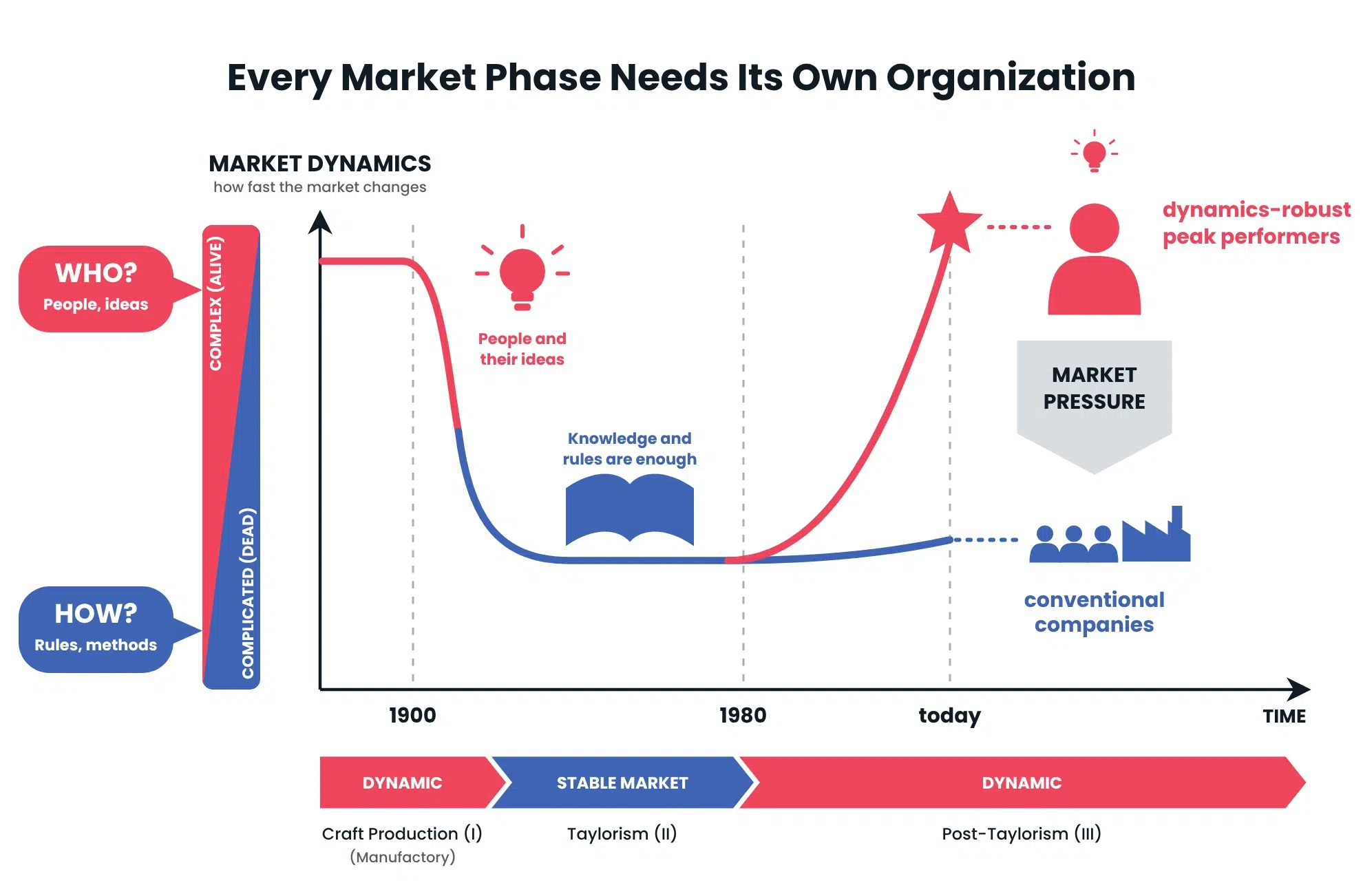
Based on a graphic by Gerhard Wohland (dynamikrobust.com).
The question “Who?” stands for people and their ideas, the question “How?” for rules and methods. When market dynamics are high, people and their ideas count. In a stable market, knowledge and rules are enough. Today the market is dynamic again. Conventional companies, though, keep following the recipe that worked in a stable market. Peak performers have adapted to the new dynamics, and they create market pressure that their competitors feel. That advantage comes from solving customers’ problems better than anyone else does. A company doesn’t need to set out to pressure its competitors. The pressure builds as customers switch over.
Which also means peak performance always depends on time and environment. What counted as peak performance fifty years ago can be the opposite today, even if an organization delivers exactly what it did back then. The market has become more dynamic, and the organization just hasn’t kept pace.
The Taylor Tub and Why the Old Formula for Success Holds You Back
From Craft Production to Taylorism
Around 1900, craft production was peak performance. Everyone knew what they were doing, and nobody managed work the way companies do today. Transport was expensive, so most markets stayed pretty much local. That made them confined: competitors couldn’t avoid one another, and that direct contact forced them to get creative.
Then transport costs fell, especially over long distances. Big markets with lots of purchasing power opened up, and competitors barely got in each other’s way, because you could simply steer around them. These markets were open and stable, meaning they changed slowly. Craft production couldn’t serve those markets cheaply enough, so companies turned their creativity inward, toward processes and costs.
Enter the engineer Frederick Winslow Taylor, who supplied the concept that fit. In his 1911 book The Principles of Scientific Management, he laid out what he called scientific management: break work into small, standardized steps and optimize them for efficiency. The goal was to take complexity and fluctuation out of production, so mass-produced goods came out cheap and predictable. To get there, Taylor separated thinking and deciding from doing. Whoever did the work no longer had to decide anything. Companies deliberately kept people’s independence to a minimum, and that’s exactly what lowered an organization’s complexity.
Carmaker Henry Ford put similar principles to work at scale, starting in 1913 with assembly-line production. Together, their names stand for an organizational form built on command, process, rules, and discipline. It fit the new mass markets, and for a long time Taylorist management was peak performance.
Why Taylorism Isn’t Wrong and Still Holds You Back
Taylorist structures aren’t wrong, not at all. As long as the market changes little, they’re unbeatable when it comes to efficiency. They become a problem once the market speeds up and the structure stays put. Wohland calls this gap the Taylor tub (in German, the Taylorwanne). Wikipedia’s entry on the high performance organization describes the model as an alternative to Taylorism. Peak performance isn’t actually new, by the way. It’s just been forgotten.
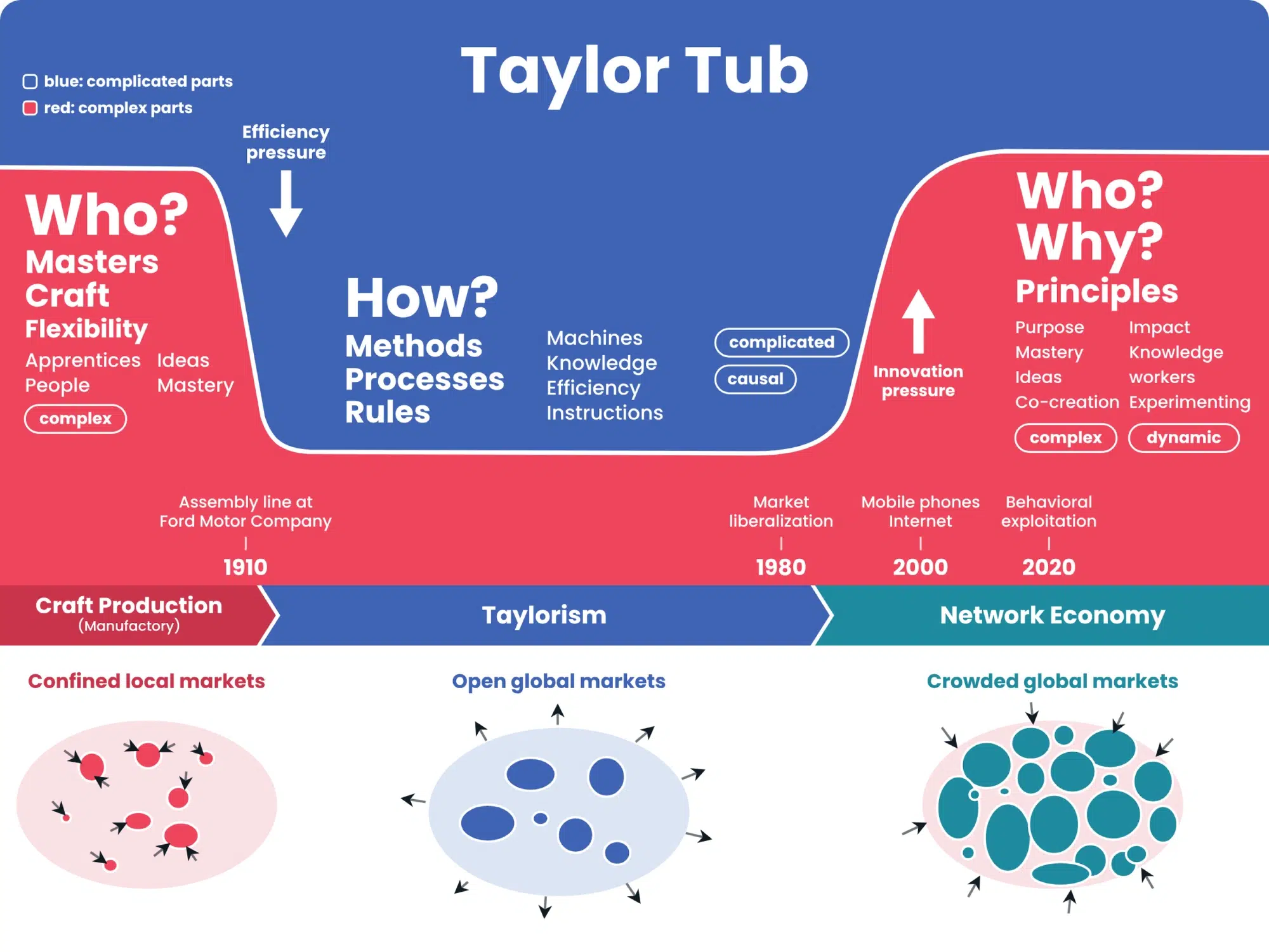
The Taylor tub. Based on an idea by Gerhard Wohland, extended by Bernd Oestereich (kollegiale-fuehrung.de/material). Redrawn as an adaptation under CC BY-SA. “Confined” and “crowded” mean that competitors can’t avoid one another, “open” means they can. The text and graphic trace back to Oestereich and Schröder, Das kollegial geführte Unternehmen (Vahlen, 2016).
Why the Market Became Crowded and Dynamic Again
Today, almost every company operates globally. A few hours is all it takes to open a business that sells worldwide, where it used to take serious capital and size. Established companies can’t grow anymore just by moving into new territory, because the markets have hit their limits. It’s crowded again, this time worldwide, and that makes it dynamic again. The graphic above points to market liberalization around 1980 and mobile phones and the internet around 2000 as drivers. The two graphics use different names for this third phase, Post-Taylorism and Network Economy. Both mean today’s phase.
Competition works differently too. Size doesn’t decide the outcome anymore, and neither does speed alone. The winner is whoever puts the right idea into practice at scale.
Blue and Red Problems
The colors in the Taylor tub graphic stand for two kinds of problems:
🔵 Blue problems are complicated: The solution exists somewhere, and you only have to find it and apply it. Processes and standards exist for exactly this. Payroll is a typical example.
🔴 Red problems are complex: The solution doesn’t exist yet. It has to emerge as an idea first and prove itself in daily work. Take a new product for customers who don’t yet know exactly what they need.
Most organizations contain both, kind of like a marble cake swirled from light and dark batter. Taylorist management is still perfectly right for the blue part. It only creates the Taylor tub when it has to solve red problems too.
Here’s where the logic flips:
| Old logic | New logic |
|---|---|
| Draw up a plan and execute it | A strategy that’s allowed to adapt |
| Management through hierarchy | Leadership that people follow voluntarily |
| Control costs | Create value for customers |
| Set goals | Start with problems |
| Copy best practices | Develop your own solutions |
Existing knowledge is enough for blue problems. Red problems need ideas. A process has none, but people do, and you can’t force them to have one. You have to live with the risk that an idea comes to them, or doesn’t.
An example: A midsize machine builder that has been managed by output and lead times for decades often sits right in the Taylor tub. The numbers say discipline and efficiency are lacking, so management tightens processes and raises targets. But the market wants more customized solutions and shorter cycles, and a purely managed organization isn’t built for that. Frankly, more control just makes the original problem worse.
Internal and External References
So why does more control backfire? Part of the answer lies in the rules themselves. Rules and metrics capture what used to work in the market. Call them internal references. People take their cues from directives inside the organization instead of from what customers need right now. The more directives there are, the more often they contradict each other, and the less anyone picks up from the market. A team that wants to solve a customer problem first has to figure out which target currently applies.
Peak-performing organizations dismantle those internal references and take their cues from external references instead: signals from the market, like a concrete customer inquiry. A separate article, Why effective collaboration still isn’t real work, explains why the external reference has to come first.
Why Organizations Often Can’t See Their Real Problem
Why the Language Is Missing
You can’t solve a problem you can’t name. Honestly, in many organizations the language for it is simply missing. Every culture has a very polite way of talking that circles problems instead of naming them. Say the problem plainly, and the culture may shut you out before anyone has listened.
A separate article explains why company culture cannot simply be decided. The short version: culture is whatever has settled in over the years, and no program changes it. That’s also one reason why organizational development rarely works at scale. It treats culture like a dial you can turn, even though culture is a symptom.
This is where outside consultants earn their keep. They don’t belong to the culture yet, so they can say what nobody inside can say without risking their standing or their backing.
Why the Concepts Are Missing
Often the right concepts are missing, too. Conventional management theory can’t see peak performance, because it knows nothing about distinctions like blue and red, or knowledge and mastery. And if you don’t draw those distinctions, you can’t see the problem, even if you’re allowed to name it.
Wohland builds on the systems theory of sociologist Niklas Luhmann. It relies less on fixed definitions than on distinctions that make connections visible. Blue and red, knowledge and mastery: those are the distinctions this article works with. Don’t confuse any of this with the systemic consulting you know from coaching and workshops.
The Official Picture and Daily Practice
Then there’s the official picture. Org charts and metrics show how an organization describes itself, which systems theorists call self-description. On the official frontstage, everything looks regulated. Backstage, people do whatever actually works. In dynamic markets, the gap between the two widens fast, because the official rules alone can’t solve the problems anymore. The next section shows where that gap becomes visible.
Where Peak Performance Already Exists: Islands of Peak Performance

How an Island of Peak Performance Forms
In many conservative organizations, peak performance already exists, just informally and outside the official processes.
The pattern usually looks like this:
➡️ Employees want to solve a problem and run into a rule that blocks exactly that.
➡️ They break the rule, feeling guilty and planning to do it by the book next time.
➡️ Next time, the next rule is in the way.
➡️ Eventually they meet others in the same boat. The clique becomes an island of peak performance.
Why Those Islands Stay Hidden
Many people have seen a visible version of this: the task force. People skip the chain of command without worrying about it, teams talk straight about the problem, and work finally feels like real work again. Then the occasion passes, business as usual returns, and nobody quite understands why that state can’t last.
Islands survive as long as someone with power shields them without looking too closely. Once an island becomes officially visible, it has to be shut down, because no leadership team can issue rules and openly tolerate people breaking them. That’s how a conservative organization survives despite its own rules. And since the problems don’t go away, other employees soon hit the same rules and start new islands, often faster than the old ones get closed.
Not Everything That Looks Like Weeds Is a Weed
For leaders, that leads to an uncomfortable conclusion. Wohland calls an organization that copes well with fast market change a dynamics-robust organization. You can’t simply plan that ability into existence. In organizations that survive, at least part of it is usually there already. And not everything that looks like weeds in the structure is actually a weed. Before you punish a rule violation, ask which problem it’s solving.
Organizations get to peak performance by two routes. Some have climbed out of the Taylor tub. Others were organized with a fair amount of complexity all along and barely realize it. They’re called naive peak performers.
Mastery Versus Knowledge, and Why Methods Alone Fall Short

Wohland distinguishes between knowledge and mastery. You can write knowledge down and buy it. Mastery is the ability to do the right thing in a given situation. It grows out of talent and experience, it draws on knowledge, too, and it only shows up in action.
An example: Almost everyone knows the rules of soccer, plenty of people know the tactics, and a lot of them play, too. That’s knowledge. What sets a professional apart is mastery: talent and years of experience, but above all the ability to do the right thing at the right moment, often without being able to explain it. A tactics book alone won’t make anyone a pro.
Organizations work the same way. Knowing a facilitation method doesn’t mean you can run a tough workshop. That takes real mastery.
Methods are knowledge in written form, and they work for blue problems. With red problems, success depends on people who bring mastery. Masters can succeed without the right method, but a method without a master usually goes nowhere. The article on the difference between a method and a tool goes deeper.
One more thing: a good idea doesn’t sell itself. It needs people who get behind it.
What Peak Performance Asks of Leadership

Authority Can’t Be Trained
If you think through what this means for your own role, you land at a pretty uncomfortable question: Do I have the talent for this problem, or don’t I? Leadership happens when others grant someone authority because they trust that person on a topic. That’s different from formal power, which a job description can hand out. You can’t order authority into existence. The people you work with give it to you, and no seminar can deliver it. If they don’t, you can put on a show of being respected, but no workforce is so oblivious that it can’t tell the difference between acted and genuine respect.
Often it helps more to find someone who truly has the talent and give them the room they need to act. And in high-performing organizations, the people at the top make the fundamental decisions themselves instead of passing them off to committees or representatives. The article on leadership development that starts with structure shows how to build a structure for this instead of training behavior. A separate article explains why power and authority are not the same thing (link coming soon).
Why Leaders Have to Endure Setbacks
An idea that holds up rarely comes out of an innovation lab. It starts as a hunch, and the hunch usually doesn’t fit. The idea that eventually proves itself in daily work is the last link in a chain of painful failures. If you can’t stand that, whether for yourself or for others, you block exactly the ideas an organization needs today.
One distinction helps here. A mistake is a deviation from something you could have known. A misjudgment is a wrong call made under real uncertainty, in a situation nobody could have foreseen. Organizations that punish misjudgments like mistakes stop experimenting. The article on how psychological safety determines whether AI transformation succeeds or fails says more.
It all comes down to one principle. In a dynamic environment, leading mostly means managing less, on purpose, exactly where managerial control gets in the way of solving problems. That’s a lot more uncomfortable than any culture program, because you have to give up real control instead of just announcing new values.
How a High Performance Organization Emerges: Find the Causes and Make Room for Leadership

You can’t set peak performance as a goal. It comes from solving problems one at a time, and it pays to ask which problems trigger others. Some problems are causes, and others are just consequences.
An example: At one company, coordination meetings, escalations, late customer orders, and overtime keep piling up. You can tackle each one separately, but they often trace back to a common cause, for example conflicting targets from sales and production. As long as nobody clarifies which one applies, every team has to renegotiate it. Solve that one cause, and a lot of the follow-on problems go away with it.
There are three steps:
➡️ Recognize. Name causes instead of treating symptoms. For every problem, ask where it comes from and what it leads to. If several problems share the same source, you’ve found the cause.
➡️ Understand. See how the parts of the organization interact, and look for structures instead of culprits or heroes. In the example, the cause is a target that people have to cope with somehow.
➡️ Lead. Add leadership to managerial control, put talent to work, and offer problems instead of handing down finished solutions. The team gets the problem and the room it needs, and works out the plan itself. The right problem motivates people more than any incentive ever could.
Continuous Innovation: Trying Ideas Out in the Market
Knowing the cause doesn’t solve anything by itself. With red problems, you can’t buy the solution off the shelf. It has to emerge as an idea. That’s what people call continuous innovation: ideas become part of daily work instead of staying confined to individual projects.
That takes a learning environment. You pick a concrete problem, try out an idea, and watch whether the problem shrinks or grows. If it shrinks, the idea works. If it grows, you were wrong, so you drop it. That’s how you weed out bad ideas early, before they get expensive.
There’s a bigger idea behind all this. When markets are this dynamic, the greatest challenge of the 21st century may well be to bring people’s abilities back into work that serves the market.
Conclusion: How a High Performance Organization Emerges
You can’t declare a high performance organization into existence. Peak performance is a by-product of an organization fitting what its market demands, and organizational performance depends on exactly that. The payoff goes beyond composure: if you solve your customers’ problems better than anyone else, you put the competition under pressure.
Four questions follow for your next decision:
1. Does the structure fit the market? Which of your problems are blue and which are red? Is the organization still using blue tools on the red ones?
2. Where is work already being done differently? Where are people breaking rules today, and what problem are they solving? Don’t tidy up the islands before you know.
3. Whom does the team trust with the problem? Who has authority on this topic, and does that person have the room to act?
4. Where is failure allowed? Is there a place where people can try out ideas and drop them without hurting anyone?
If you want to start tomorrow, pick a problem that hasn’t moved in months. Ask whether it’s blue or red, and whether it’s a cause or just the consequence of something else. Start there, and you’ll quickly see whether the organization needs to row harder or trim its sails differently.
Get in Touch
If your organization keeps demanding more effort while the structure stays the same, take a look at where managerial control is blocking red problems.
In a first conversation, I’ll look with you at where the real levers are in your organization. It’s free, with no pitch and no obligation.